Product
Connect to any business system, wherever it runs
connects to your ERP, CRM, order management and any other system through Model Context Protocol -- the open standard for AI-to-system communication. Cloud, on-premises, or custom-built.
Yoursystemsstaywheretheyare.
Yourcustomersreachtheanswerstheyhold.
How it works
One protocol connects every system
Model Context Protocol is the open standard that Claude, ChatGPT, Gemini, and every major AI platform supports. It provides a universal interface between AI agents and business systems. oHallo was built on MCP from day one.
First-class integration
Any system with an MCP endpoint. Including the ones no marketplace will ever cover.
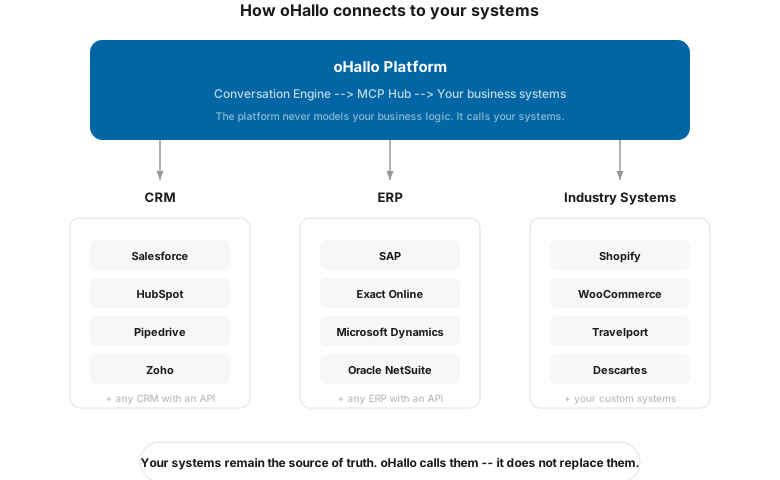
Most AI platforms in the category ship a fixed marketplace of pre-built connectors to a finite list of standard SaaS tools. Anything outside that list waits for a vendor roadmap. oHallo takes the opposite position. Any system that can expose an MCP endpoint is a first-class integration -- including enterprise software like SAP, Microsoft Dynamics 365, Odoo, and NetSuite, e-commerce platforms like Magento and Shopify, CRMs like Pipedrive, HubSpot, and Salesforce, and any legacy or bespoke system your engineering team can front with an MCP server.
Connections
Three groups of connections, one open standard
Every connection uses the Model Context Protocol. MCP servers run on your own infrastructure, which keeps every integration portable across AI vendors. This is not a proprietary connector marketplace.
System MCPs
Built into the platform and always available on every plan. Knowledge base, policies, calendar, bookings, and CRM are MCP connections with no setup required.
MCPs for common operational systems
MCP servers for the widely-used operational software a mid-market business typically runs: ERP, CRM, e-commerce, finance, PIM, logistics. You run them on your own infrastructure or, for common deployments, have them hosted on your behalf. Specific named systems include Pipedrive, HubSpot, Salesforce, SAP, Dynamics 365, Odoo, Magento, and Shopify.
Custom MCPs
For legacy software, bespoke tools, and in-house systems no marketplace will ever cover. Your engineering team deploys an MCP server alongside the system it connects to. Because MCP is an open specification, the work is straightforward -- and once the server exists, pointing a specialist agent at it takes minutes.
The connection lifecycle
From credentials to resolution in minutes
Connect
You provide API credentials for your business system. These are stored in encrypted secrets management and never touch the application database.
Test
The platform verifies that the connection reaches your system and that the credentials are valid before anything goes live.
Discover
Once connected, the platform discovers every tool your system exposes -- order lookup, invoice retrieval, stock check, return processing, and more.
Bind
You create a specialist agent and bind it to the connection, choosing which tools the agent can access and which policies govern its behaviour.
Resolve
The orchestrator dispatches to your agent automatically when a matching customer query arrives, retrieving live data and composing a validated reply.
Everycompetitorwasbuilt
onproprietaryconnectors.
wasbuiltontheopenstandard.
Specialist agents
Every connected system becomes a capability your specialist agents can act on
You create specialist agents and bind each one to the MCP connections it needs. Each agent handles a specific domain -- orders, invoicing, logistics, product specifications, claims, renewals -- and the platform expands its resolution capabilities every time you connect a new system.
You define the scope
You name the agent, describe what it handles, and select which tools on which MCP connection it can access. The orchestrator dispatches to it automatically when a matching query arrives.
Your policies govern every action
Before any specialist agent calls any tool on any connected system, the policy layer checks the action against the rules you configured. Policies also encode your standard operating procedures so the agents follow the way your business actually operates.
Deployment
MCP servers run wherever your systems are
Cloud
SaaS platforms, cloud ERPs, and hosted services. The MCP server runs alongside your system in the same cloud environment.
On-premises
Behind your firewall, on your infrastructure. The MCP server runs inside your network and oHallo connects over a secure tunnel. Your data never leaves your environment.
Security
Every tool call is governed by policy
Before a specialist agent calls any tool on any connected system, the policy enforcement engine evaluates whether the action is permitted. It checks whether the agent is authorised, whether the request falls within configured limits, and whether human approval is required. Every decision is logged in the audit trail.
Credentials are stored in encrypted secrets management and resolved at runtime only, never in the application database.
From connected system to a resolving specialist agent in minutes
Connect your systems through the open standard and let the agents get to work